


Concentration is not like a bulb that we can turn on and off with a switch, because we are not just the bulb; we are also the switcher and the switch.
Hello. I’ve paused subscription billing for a month to take some pressure off myself. It’s the Substack equivalent of trading queens to enter an endgame a pawn up. We need to know when to make those decisions, particularly on those days when you don’t feel you have the wherewithal to execute your calculation-intensive sacrificial attack.
I need a break from writing and thinking in general to be honest, and Chess Therapy was always my fun-when-time-allows site. If there’s a chance of me bringing chess back into my life, the priority is not to fall apart. I hope to reconnect with my store consciousness and rebuild concentration to help navigate the next phase of my life.
I am reminded that as a twenty-something chess climber, before major tournaments, I used to take several days beforehand to build up concentration. I would listen to music as if introjecting harmony, go for long walks as if I were irrigating my soul, and I would do Yoga to steady my nervous system, often doing full head-stands and thinking, upside down: “From this position, I must surely have some kind of advantage…”
In recent months, my concentration has not been so great, but I have given the subject matter a fair amount of thought, and chess has helped me to understand what it means to concentrate, and what, therefore, follows for what I have to do.
In 2020, I published an essay in Aeon magazine that might be one of my best, partly because it was excellently and thoroughly edited by Marina Benjamin. I have shared a sample of paragraphs here, and would encourage you to follow the link at the end for the whole thing.
Bye for now, and good luck building your concentration.
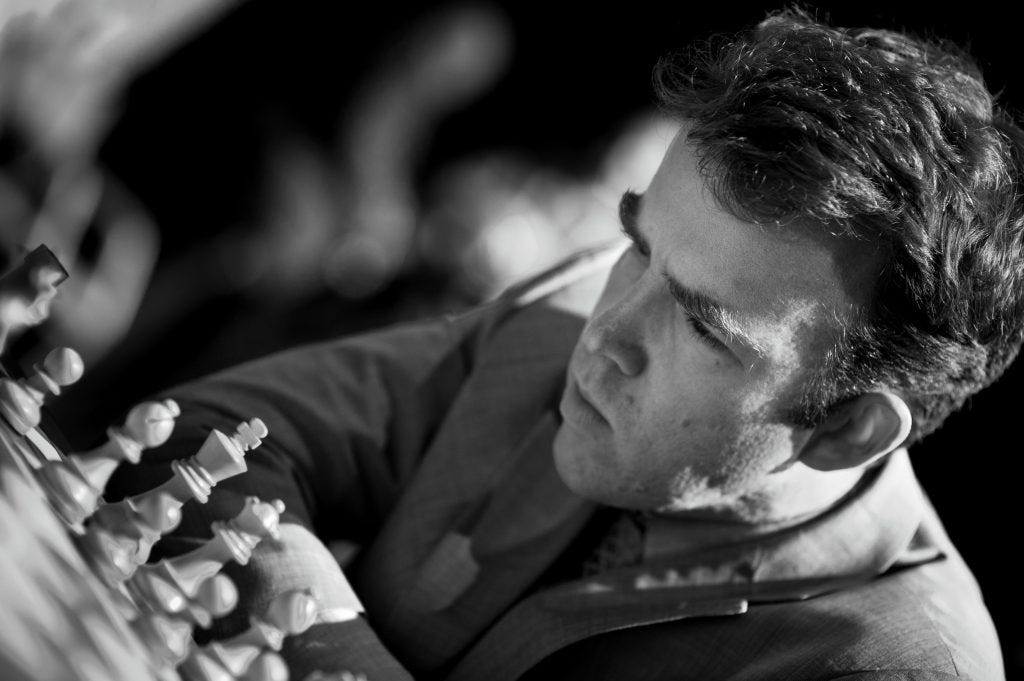
Arriving at the chess board is like entering an eagerly anticipated party. All my old friends are there: the royal couple, their associates, the reassuringly straight lines of noble infantry. I adjust them, ensuring that they are optimally located in the centre of their starting squares, an anxious fidgeting and tactile caress. I know these pieces, and care about them. They are my responsibility. And I’m grateful to my opponent for obliging me to treat them well on pain of death
…
In recent years, I have worked in academic and public policy contexts, attempting to integrate our understanding of complex societal challenges with our inner lives, while also looking after my two sons. I miss many things about not being an active player. I miss the feeling of strength, power and dignity that comes with making good decisions under pressure. I miss the clarity of purpose experienced at each moment of each game, the lucky escapes from defeat, and the thrill of the chase towards victory. But, most of all, I miss the experience of concentration.
I can still concentrate, of course, but not with the same reliability and intensity that a life of professional chess affords. In fact, from a distance, chess looks to me suspiciously like a socially permissible pretext to concentrate for several hours at a time. In The Island from the Day Before (1994), Umberto Eco composes a love letter that includes the line: ‘[O]nly in your prison does [my heart] enjoy the most sublime of freedoms’ – that could be said of chess, too, and the experience of concentration is what makes it possible. I believe concentration is a defining feature of a fulfilling life, a necessary habit of mind for a viable civilisation, and that chess can teach us more about what concentration really means.
…
Any skilled endeavour entails concentration, but chess is unusual in requiring that we concentrate not for a few minutes at a time, but for several hours at a time, within tournaments, for days at a time, and within careers, for years at a time. Concentration is the sine qua non of the chess experience.
In chess, concentration usually unfolds in quick succession through perceiving, desiring and searching. But it’s recursive, so I often find something I didn’t expect in a way that leads me to see my position differently and want something else from it. My perception is pre-patterned through years of experience, so I don’t see one square or piece at a time. Instead, I see the whole position as a situation featuring relationships between pieces in familiar strategic contexts; a castled king, a fianchettoed bishop, a misplaced knight, an isolated pawn; it’s a kind of conceptual grammar. The meaning of the position is embedded in those patterns, partly revealed and partly concealed, and my search to do the right thing feels fundamentally aesthetic in nature.
I could describe the feeling as a kind of evaluative hunting – not so much for a particular target, but for trails of ideas that look right and feel right. I am drawn towards some transfigurations of the patterns that make me look deeper, and repelled by others. Good moves have the qualities of truth and beauty. They are discoveries of how things are, and should be
…
Concentration is not like a bulb that we can turn on and off with a switch, because we are not just the bulb; we are also the switcher and the switch. Humans are more like thermostats receiving and sending out signals, seeking the optimal ‘mental temperature’ as ambient conditions around and within us change, and we’re often abruptly adjusted against our will. We succeed in concentrating when we manage to convene the dispositions that matter for a task at hand – for instance, our awareness, attention, discernment and willpower – and that is possible only if the right emotions co-arise and come along for the ride.
Concentration is therefore best understood as a kind of coalescence. The ultimate aim might be single-pointed attention, but the process of concentrating is more like a method of corralling and coordinating fissiparous parts of our psyche. The best illustration of this idea is traditional forms of yoga, which is practised through seemingly elaborate asanas (postures) such as standing on your head, and forms of pranayama (breathing) in which you pump stale air out of your lungs through your nostrils as a kind of spiritual snorting. Such practices have value on their own terms, but their ultimate purpose is the experience of realisation in which our nervous systems are sufficiently settled through training that we can sit still, free of mental agitation, for more than a few seconds at a time.
Please see the full essay in Aeon magazine.
Bye for now,
Jonathan.